The Hidden Persuaders
Make readers alert to forms of persuasion that Packard argues work beneath ordinary awareness, and invite scrutiny of both their claimed methods and their implications for personal choice.
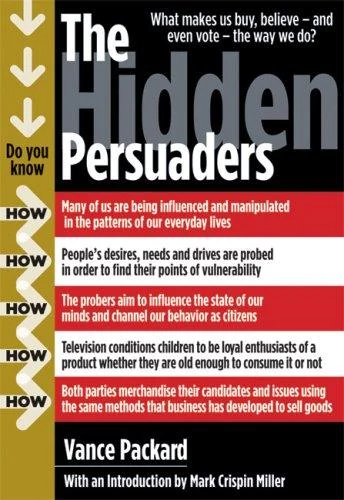
Read the decisions beneath the cover.
Make a broad investigation develop by changing the stakes of each setting, then distinguish doubts about the methods from the values defended in the conclusion.
Especially useful for: Writers of investigations and critical nonfiction whose many cases span consumer, organizational and civic life, with disputed evidence behind a moral argument.
How the decisions work together
Packard builds a large case catalog into a sequence by moving from merchandising to citizenship and then turning back toward the validity of the evidence. The final ethical question supplies a distinct destination, while the reissue’s critical introduction makes the limits of that sequence unusually visible.
- Introduce the approach and its sources
The opening explains the investigation, its reported methods and the practitioners supplying much of the evidence.
- Group consumer cases
The first major part organizes applications by appeals, products, settings and audiences.
- Change the stakes
An explicit hinge leads into political choice, organizational conformity, institutional consent and public confidence.
- Separate the closing questions
The final part examines validity, then morality, ending with Packard’s defense of mental privacy and choice.
2 decisions worth studying.
Start with the choice. Open its application and limits, or follow the source example.
Let each larger setting change the question
Carry a central idea into a broader setting while identifying the new constraint, relationship or consequence that the change of setting introduces.
Explore the decision, application & limits
Why this choice matters
The consumer chapters establish the book’s account of persuasion before the citizen chapters change what is being sought from the audience. In the political opening, the ability to withhold a vote or support makes the setting consequential; this gives the later material a different question instead of merely another list of clients.
Try the decision in your own work
- Identify what stays constant across the settings so the reader can recognize the continuing inquiry.
- State the new relationship or constraint before introducing more cases.
- Make the evidence in the new domain answer that changed question, and qualify any claim that effects transfer across domains.
Give validity and morality separate examinations
After presenting a practice and its reported consequences, explicitly examine the evidentiary basis of its claimed effectiveness, then reconsider identifiable practices under a distinct stated ethical question.
Explore the decision, application & limits
Why this choice matters
The last two chapters create different tasks for the reader: assess the claims supporting earlier accounts, then judge what the author believes is permissible or valuable. The division can keep an ethical conclusion from depending invisibly on an exaggerated account of technical power, although Packard does not fully resolve the evidentiary problems he raises.
Try the decision in your own work
- Identify which earlier claims depend on disputed methods and give their strongest relevant limitations a visible place.
- Distinguish evidence of use, claimed effectiveness and demonstrated effect rather than allowing one to stand for the others.
- When moving to the ethical question, revisit recognizable practices and state the value at stake without treating unresolved empirical claims as settled.
Every chapter has a job.
Choose a section to see what it adds and which authoring decisions it makes visible.
New Frontiers for Recruiting Customers
The account follows attempts to expand demand through additional purchases, replacement and leisure. Its closing transition explicitly announces a move from merchandising to political and organizational persuasion.
Its job in the book
Complete the consumer cases and prepare a change in scale.
A decision to study
Name both the continuity of the method and the new stakes before moving into another part of the book.
Supplied text · lines 1477–1563. Summary and role are our analysis.
Link to this chapterThe book’s subject and overall argument
Vance Packard investigates the uses of motivational research and psychological interpretation in mid-century American persuasion. He begins with the claims, practitioners and techniques of the approach, then groups reports about consumer marketing around images, anxieties, status, products and audiences. The account subsequently extends to political campaigns, workplace relations, public relations and the cultivation of confidence. Its reported successes and explanations are claims by Packard and his sources, many of whom are practitioners describing their own work.
The final two chapters separate scrutiny of the methods from the author’s moral concerns. Packard acknowledges problems of interpretation, sampling, validation and confirmation, while continuing to regard the approach as consequential. His ending defends privacy and the ability to choose, including knowingly irrational choices. The supplied reissue adds a substantial introduction by Mark Crispin Miller that both criticizes and defends the original book; Miller’s later historical and political framing is distinct from Packard’s text.
Build familiarity with the reported techniques through consumer cases, then widen the settings to citizenship and organizational life. Before the closing moral argument, turn scrutiny back onto the research that supplied many of the book’s own accounts; the validity and morality chapters ask related but distinct questions.
Sources & reading scope
Vance Packard, The Hidden Persuaders; supplied Ig Publishing ebook, eISBN 978-1-935-43953-0, with Mark Crispin Miller’s introduction copyright 2007; Packard text copyright 1957 and 1980; local filename dated 2011.
The completed whole-source AI synthesis supplied candidate observations and the broad argument map. This Codex editorial pass checked original source headings, section boundaries, openings and selected argumentative contexts; inspected every retained example; checked the existing pattern dictionary and base examples; and rewrote or rejected nominations. It is a source-checked editorial pass, not a new independently adjudicated whole-book reading.
- No human or independent-model review has been completed.
- The local extraction has not been compared page by page with a publisher edition; graphical layout and completeness are not independently certified.
- The book’s empirical and historical claims are described as claims made by the author, not independently verified findings of this study.
- Proposed effects on readers are editorial interpretations, not measured comprehension, behavior or longevity effects.
- The inspected source includes Miller’s four-part introduction and its notes, all twenty-three Packard chapters, three main group headings and copyright/cataloging material. The chapter map includes the introduction as one attributed unit and all Packard chapters.
- The local filename is dated 2011, while the source gives Packard copyright 1957/1980 and Miller introduction copyright 2007, with cataloging data for the Ig edition. No precise 2011 publication statement was located in the text; the edition field preserves that distinction.
- Cataloging information mentions a 1980 reissue with a new afterword, but this extraction contains no separately headed afterword. Its absence is recorded rather than filling one in or certifying equivalence to every earlier edition.
- Miller wrote the introduction; he is not treated as co-author of the original investigation. His judgments about reception, historical originality and political consequences are attributed to him, not adopted as findings of this study.
- Motivational, psychological, commercial and political claims remain historical claims in this text. Practitioner reports of results, causal interpretations and forecasts are not independently verified, and no current psychological or advertising advice is offered.
- The source contains typographical and extraction errors. Short retained quotations are checked literally against this text; visual fidelity and complete correspondence to a publisher edition are not certified.
- The whole-source draft’s proposed ending example misattributes some self-indulgent purchases to Packard himself. LF2267 describes people he encountered; his own preference appears separately at LF2271. The record does not repeat that error.
Editorial source check by Codex. No human or independent-model review is claimed. Chapter locations refer to the supplied transcription, not printed page numbers.