Give validity and morality separate examinations
After presenting a practice and its reported consequences, explicitly examine the evidentiary basis of its claimed effectiveness, then reconsider identifiable practices under a distinct stated ethical question.
Critical nonfiction where the evidence for a practice’s effectiveness and the ethics of its use are both contested.
Distinct examinations can prevent a closing judgment from hiding which claims are empirical and which values are being defended; their placement and adequacy still require scrutiny.
Audit the methods behind identifiable earlier claims, then return to recognizable practices under an explicitly different ethical question.
The last two chapters create different tasks for the reader: assess the claims supporting earlier accounts, then judge what the author believes is permissible or valuable. The division can keep an ethical conclusion from depending invisibly on an exaggerated account of technical power, although Packard does not fully resolve the evidentiary problems he raises.
Every identified example.
2 source-checked examples from the published book studies. The full catalog has not been assessed for this practice.
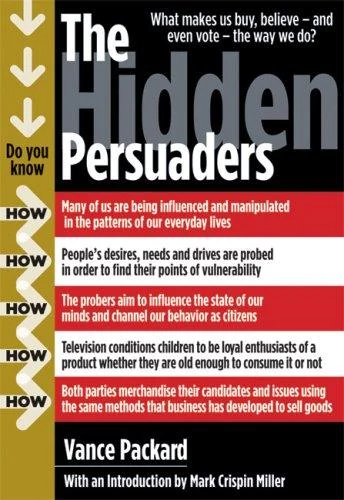
The Hidden Persuaders
Vance Packard · 50 weeksThe inquiry examines the methods behind its own cases
SHORT SOURCE EXCERPT“initial idea a conclusion”
Packard says many earlier accounts rest on motivational analysts’ findings and acknowledges that readers can reasonably question their methods. He organizes criticism into four areas, including the danger of taking a preliminary idea as a conclusion, and describes the need for confirmation alongside examples of more elaborate testing.
The investigation exposes a weakness in its own evidentiary foundation rather than limiting scrutiny to the persuaders’ intentions. Grouped objections provide specific questions with which to revisit the earlier reports.
The Hidden Persuaders
Vance Packard · 50 weeksEarlier practices return as questions about a protected value
SHORT SOURCE EXCERPT“privacy of our minds”
The final chapter turns recurring practices—appeals to children, voters, anxieties, charity and consumption—into explicit questions about moral responsibility. It considers professional codes and a broader conflict over consumption, then ends by defending mental privacy and the possibility of choosing even irrationally.
The ending identifies a value different from technical effectiveness or perfect rational behavior. Returning to recognizable practices gives the ethical discussion a concrete object after the preceding chapter’s scrutiny of methods.
Make the decision
deliberately.
Useful for an investigative or argumentative book in which a troubling practice has both disputed effects and contested purposes, and the ending must clarify which kind of judgment it is making.
- Identify which earlier claims depend on disputed methods and give their strongest relevant limitations a visible place.
- Distinguish evidence of use, claimed effectiveness and demonstrated effect rather than allowing one to stand for the others.
- When moving to the ethical question, revisit recognizable practices and state the value at stake without treating unresolved empirical claims as settled.
A near miss
Put a brief disclaimer before a denunciation while continuing to treat all disputed effects as proved, or assume that a practice’s effectiveness alone settles its morality.
Where the lesson stops
Packard places the methodological examination late, after many vivid cases. He continues to rely partly on adoption and practitioners’ judgments, so the chapter structure does not establish that the claims have been validated or that his moral conclusion follows automatically.
This is an editorial reading of craft. These examples do not establish that the practice caused, or predicts, a longer bestseller run.