The inquiry examines the methods behind its own cases
After presenting a practice and its reported consequences, explicitly examine the evidentiary basis of its claimed effectiveness, then reconsider identifiable practices under a distinct stated ethical question.
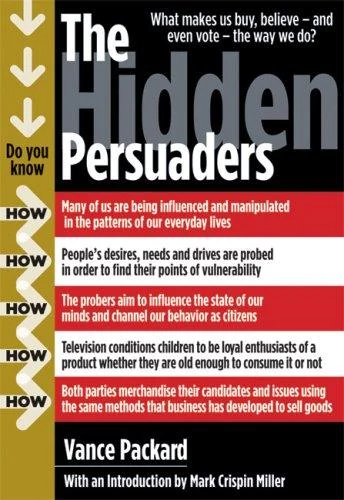
The Hidden Persuaders
Vance Packard · 50 weeksThe inquiry examines the methods behind its own cases
SHORT SOURCE EXCERPT“initial idea a conclusion”
Packard says many earlier accounts rest on motivational analysts’ findings and acknowledges that readers can reasonably question their methods. He organizes criticism into four areas, including the danger of taking a preliminary idea as a conclusion, and describes the need for confirmation alongside examples of more elaborate testing.
The investigation exposes a weakness in its own evidentiary foundation rather than limiting scrutiny to the persuaders’ intentions. Grouped objections provide specific questions with which to revisit the earlier reports.
The source in context.
Packard examines criticism of the research that underlies many earlier cases. Four grouped objections address overclaiming, clinical tools applied to mass behavior, dependence on individual interpretation and insufficient confirmation, before he explains why he still regards the field as consequential.
Open this chapterWhat this example supports
The investigation exposes a weakness in its own evidentiary foundation rather than limiting scrutiny to the persuaders’ intentions. Grouped objections provide specific questions with which to revisit the earlier reports.
Its limit
The chapter reports arguments and procedures; this study does not certify the validity of those procedures. Its caution also arrives after the case material, and the book does not systematically re-test or withdraw each earlier assertion.
Source & edition
Vance Packard, The Hidden Persuaders; supplied Ig Publishing ebook, eISBN 978-1-935-43953-0, with Mark Crispin Miller’s introduction copyright 2007; Packard text copyright 1957 and 1980; local filename dated 2011.
Supplied text, lines 2036–2108. The short quotation is checked against the source.
The completed whole-source AI synthesis supplied candidate observations and the broad argument map. This Codex editorial pass checked original source headings, section boundaries, openings and selected argumentative contexts; inspected every retained example; checked the existing pattern dictionary and base examples; and rewrote or rejected nominations. It is a source-checked editorial pass, not a new independently adjudicated whole-book reading.
supplied Ig Publishing ebook, eISBN 978-1-935-43953-0, with Mark Crispin Miller’s introduction copyright 2007; Packard text copyright 1957 and 1980; local filename dated 2011