Hunt, Gather, Parent
The book promises a wider set of ways to cooperate with children and reduce household conflict, demonstrated through reported families, the author’s own learning, and practices readers can try.
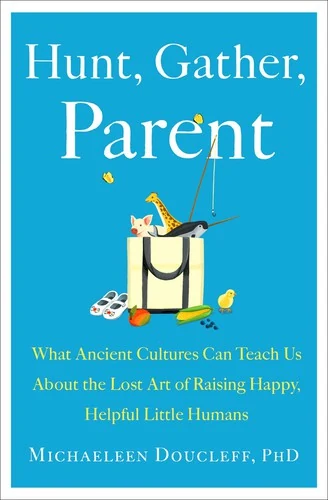
Read the decisions beneath the cover.
Keep the narrator's unresolved problem in view so reported discoveries can return as specific attempts, refinements, and choices for the reader.
Especially useful for: Writers combining reporting or a learning journey with practical guidance that must travel between different settings.
How the decisions work together
The promise of more cooperative family life begins with the narrator's own difficulty. Encounters with other families supply scenes and questions; explanations, home trials, and exercises then make attempted transfer visible. TEAM interludes gather the developing framework as the book moves through different settings, rather than leaving the scenes as separate travel episodes. The final sleep chapter returns the accumulated ideas to an unresolved household problem. The pattern of discovery and attempted use connects the personal story to the instructional purpose without making the reported outcomes controlled evidence.
- Establish an unresolved problem
Begin with household conflict and encounters that challenge familiar assumptions about parenting.
- Move from observation to use
Connect reported interactions to explanation, attempts with Rosy, and reader exercises; gather the ideas in TEAM interludes.
- Return to a remaining difficulty
Use the final sleep chapter to apply ideas developed across the book to a concrete problem still facing the family.
3 decisions worth studying.
Start with the choice. Open its application and limits, or follow the source example.
Make an idea concrete before its formal unpacking
A local case exhibits the traits that the following explicit explanation brings together, even if a title or earlier preview has already named the concept.
Explore the decision, application & limits
Why this choice matters
A concrete episode supplies a referent for the formal explanation, and here it also connects the book’s cross-cultural argument to an American family scene. That reading effect is an editorial interpretation.
Try the decision in your own work
- Select a scene that embodies the relevant relation through action.
- Name which feature of the scene the explanation will organize.
- Distinguish a first naming from a fuller definition after earlier previews.
Carry a reported tool into the narrator’s own difficulty
A reported interaction is followed by a separately identifiable home trial that names what the author tries and what she notices.
Explore the decision, application & limits
Why this choice matters
The second setting gives readers a concrete bridge from observation to attempted use. The reported result can motivate investigation without serving as controlled proof.
Try the decision in your own work
- State the behavior observed and the problem it might address.
- Show what the narrator actually changes in a comparable encounter.
- Separate the noticed outcome from claims about effectiveness for other people.
Offer several levels of entry into a practice
An application section gives a cautious starting option and progressively more involved versions of the same approach.
Explore the decision, application & limits
Why this choice matters
A reader can identify an initial action without accepting the most demanding or unfamiliar version at once. This is a plausible design purpose, not a tested conversion effect.
Try the decision in your own work
- Name a concrete low-commitment start.
- Make later tiers differ in the action or commitment they require.
- Let the format fit the practice; do not force every exercise into identical tiers.
Every chapter has a job.
Choose a section to see what it adds and which authoring decisions it makes visible.
A New Paradigm for Western Parents
The interlude gathers the TEAM elements and distinguishes broad organization of family life from moment-to-moment intervention. A walking-toddler comparison makes that distinction concrete.
Its job in the book
Integrate the accumulated concepts into a final organizing account.
A decision to study
Change scale explicitly when combining principles that operate at different levels.
Supplied text · lines 4455–4534. Summary and role are our analysis.
Link to this chapterThe book’s subject and overall argument
Michaeleen Doucleff builds a parenting book around a reporting journey taken with her young daughter, Rosy. After describing conflict at home and questioning familiar Western assumptions, she visits Maya, Inuit, and Hadzabe families and combines those encounters with interviews and published research. Her TEAM framework gathers the book’s proposed approach around togetherness, encouragement, autonomy, and minimal interference.
The instructional rhythm repeatedly moves from a household scene to an explanation and then to a trial in Doucleff’s own family or a reader exercise. The TEAM interludes collect and extend ideas between the numbered chapters, while the last chapter applies them to a remaining problem: sleep. This design links a personal transformation story to a practical manual. Its reported home outcomes are personal accounts, and this study analyzes the writing rather than independently endorsing the parenting claims.
Use a recurring movement from observed family life to interpretation to home application, while the TEAM interludes make the developing framework explicit. Keep the author’s unresolved problems available so later chapters can demonstrate application rather than merely repeat principles.
Sources & reading scope
Michaeleen Doucleff, Hunt, Gather, Parent; inspected local source text, local extraction whose copyright leaf states ©2021 and First Avid Reader Press hardcover edition March 2021; the source filename says 2022.
Codex editorial pass used the existing whole-source AI draft as a set of nominations, checked the original local source at every quoted example and its surrounding passages, checked chapter headings and section order, and rewrote or narrowed the selected interpretations. Chapter maps combine that draft with direct checks of headings, openings, and selected passages; this pass is not a new page-by-page reading or an independent-model review.
- No human review or independent-model review has been completed.
- The local extraction has not been compared against a publisher-controlled edition for completeness or layout fidelity.
- Craft effects are interpretations of textual structure, not measured effects on readers or explanations of sales.
- Claims made inside the book are attributed to the book; this editorial pass does not independently validate its empirical findings.
- The prologue announces a four-element approach, and the TEAM 1 heading names the framework before the bakery scene. The selected lesson concerns the fuller explanation that follows the scene, not first disclosure of the framework’s existence.
- Exercise formats vary. Try It 6 has three commitment tiers; Try It 1 groups advice by age and Try It 4 begins with numbered actions. The draft’s uniform-ladder claim was rejected.
- The copyright leaf identifies 2021; the unverified source filename’s 2022 label is not treated as publication evidence.
Editorial source check by Codex. No human or independent-model review is claimed. Chapter locations refer to the supplied transcription, not printed page numbers.