Cosmos
Understand the universe as a setting for human life, and see how observation, imagination and correction make parts of that setting knowable.
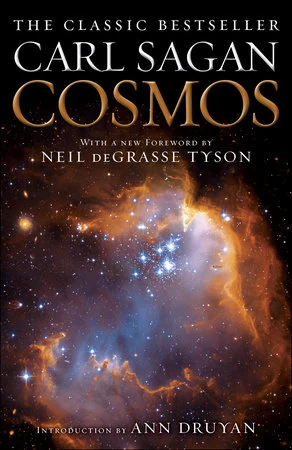
Read the decisions beneath the cover.
Give a large explanatory journey recurring questions, visible reasoning and concrete returns that connect remote subjects to the reader’s world.
Especially useful for: Writers explaining a broad technical or historical subject whose parts need a shared human question.
How the decisions work together
The promise of locating humanity within the universe shapes both a cosmic tour and a history of inquiry. Worked investigations show how knowledge changes, while a familiar object can carry a technical chapter from ordinary matter to stellar processes. Questions of communication and civilization then prepare the closing argument about human survival.
- Locate the reader
Move between cosmic scale and concrete ways people have investigated it.
- Make the reasoning visible
Use failed models, worked assumptions and material connections to organize demanding explanations.
- Return with a stake
Connect the accumulated perspective to communication, responsibility and survival.
3 decisions worth studying.
Start with the choice. Open its application and limits, or follow the source example.
Let a failed prediction improve the explanation.
Establish a plausible model, show a specific observation it fails to explain, and revisit the same problem with a revised model.
Explore the decision, application & limits
Why this choice matters
The discrepancy gives the change of model a reason the reader can follow. The new account answers a visible failure, making revision part of the chapter’s explanation of scientific work.
Try the decision in your own work
- State the initial model and the observations it seems to fit.
- Show the remaining discrepancy at a scale readers can understand.
- Return to the same observations after explaining exactly what the revised model changes.
Let the reader reconstruct the inference
Present concrete inputs and the intermediate reasoning steps that connect them to a conclusion, including a revealing wrong move or alternative where available.
Explore the decision, application & limits
Why this choice matters
The equation separates quantities the author regards as better known from conjectural choices. Contrasting civilization-lifetime assumptions shows why the final estimate also carries the book’s concern about survival.
Try the decision in your own work
- Define the inputs and distinguish measured quantities from conjectural estimates.
- Show the intermediate combinations before presenting the total.
- Work through a plausible change in an uncertain input and explain which conclusion changes.
Every chapter has a job.
Choose a section to see what it adds and which authoring decisions it makes visible.
The Persistence of Memory
Genes, brains and libraries appear as different ways information can persist. The opening attention to nonhuman life eventually connects with the Voyager recording and the question of what a civilization chooses to communicate.
Its job in the book
Connect biological inheritance, thought and culture through one organizing question.
A decision to study
Compare distinct mechanisms under a shared question without treating the mechanisms as interchangeable.
Supplied text · lines 2791–3002. Summary and role are our analysis.
Link to this chapterThe book’s subject and overall argument
Cosmos connects an account of the universe with an account of how people learn to understand it. Journeys through space, historical investigations, thought experiments and worked reasoning let the book move between immense scales and particular human questions.
Its thirteen chapters repeatedly connect remote subjects to earthly life: matter, memory, the possibility of other civilizations and the future of our own. The final survival argument draws on concerns introduced throughout the tour; two mathematical appendices let interested readers inspect supporting arguments in greater detail.
A cosmic tour repeatedly returns to the people and methods that explain what is seen, then makes humanity’s place in the universe the basis of a closing survival argument.
Sources & reading scope
Carl Sagan, Cosmos; supplied English text, introduction dated May 1980, precise edition unverified.
The completed whole-source AI draft supplied the broad architecture and candidate observations. This Codex editorial pass checked the original contents, all thirteen main chapter headings and boundaries, introduction and appendix headings, selected chapter opening/ending contexts, and the full retained example contexts. Existing pattern definitions and already reviewed examples were checked before writing this record. This was a targeted source-checked editorial pass, not an independent whole-book rereading.
- No human or independent-model review has been completed.
- The supplied extraction has not been compared page by page with a publisher edition; equation formatting and missing visual information limit layout analysis.
- The filename’s 1980 date is not sufficient to identify the edition; the biography includes later information.
- Historical and scientific statements are described as the book’s claims, not independently verified or updated scientific guidance.
- Suggested reader effects are editorial interpretations, not measured comprehension, behavior or longevity effects.
Editorial source check by Codex. No human or independent-model review is claimed. Chapter locations refer to the supplied transcription, not printed page numbers.