A chapter closes on two outcomes and a stated difference
Develop a case, then close its local account with a brief comparison that names a counterpart and contrasts their treatment or consequences; repeat that closing role across otherwise separate cases.
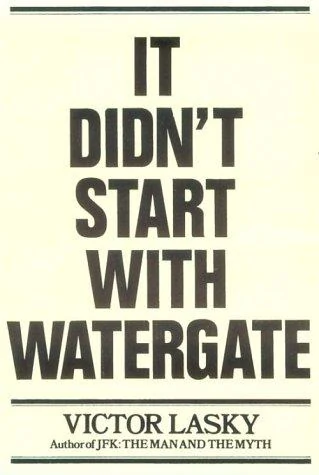
It Didn't Start with Watergate
Victor Lasky · 23 weeksA chapter closes on two outcomes and a stated difference
SHORT SOURCE EXCERPT“Not as lucky as Strauss”
After describing a change in the limitations period and Strauss’s account of receiving funds, the chapter closes by bringing in Stans’s guilty plea and fine, followed by Strauss’s continuing party role. The text itself says Stans could not use the same limitations protection.
Stans enters the final paragraph as Strauss’s named counterpart, and the account closes by contrasting a plea and fine with a continuing party role. The expressly different limitations position also shows why an explicit comparative close can remain an unsupported equivalence rather than a complete explanation.
The source in context.
A portrait of the impeachment inquiry leads into criticism of reporting, transcript interpretation and political financial practices. The chapter closes by contrasting the outcomes for Strauss and Stans while naming a difference involving the statute of limitations.
Open this chapterWhat this example supports
Stans enters the final paragraph as Strauss’s named counterpart, and the account closes by contrasting a plea and fine with a continuing party role. The expressly different limitations position also shows why an explicit comparative close can remain an unsupported equivalence rather than a complete explanation.
Its limit
The author attributes the legislation to protective motives, but this study has not verified that claim or the legal merits of either case. The different limitations position limits any simple same-conduct/different-treatment conclusion.
Source & edition
Victor Lasky, It Didn't Start with Watergate, supplied text with The Dial Press, New York, 1977 title page.
Supplied text, lines 17440–17526. The short quotation is checked against the source.
Read the existing whole-source synthesis and all ten ordered segment summaries, section maps, qualifications and gap reports. Checked all 23 actual numbered chapter headings and their opening and closing passages, the complete narrative ending, and the Sources and Index boundaries. Read every retained example and its surrounding comparison, with the relevant chapter-source entries. Checked selected alternative candidates and author-position disclosures. Verified all ten consecutive source-input hashes and successful machine receipts. This is source-checked editorial review using the prior machine reading, not a new second full-book reading, independent model review or historical/legal fact audit. Private v2 revision rechecked the three retained passages and their source entries, two internal nonexamples, actual final prose and apparatus continuation under current source gates. It compared the proposal with all 46 canonical definitions at the recorded snapshot and reverified all ten complete source-input receipts. Earlier complete heading and ordered-report review is preserved; this bounded revision is not another full-book reading.
Supplied text with a title page naming The Dial Press, New York, 1977; separate copyright and digital-edition details not independently established.