A chapter closes with a conditional comparison
Develop a case, then close its local account with a brief comparison that names a counterpart and contrasts their treatment or consequences; repeat that closing role across otherwise separate cases.
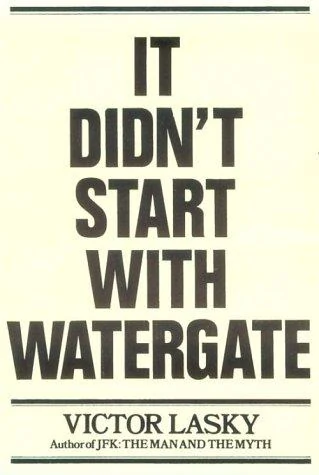
It Didn't Start with Watergate
Victor Lasky · 23 weeksA chapter closes with a conditional comparison
After recounting allegations against Kissinger and selected expressions of support, Lasky closes with Davidson’s conditional question: if an exception is made for Kissinger, should Nixon’s foreign-policy achievements earn similar treatment? The question supplies the comparative close without establishing that a rule was actually waived.
The final question returns an extended Kissinger account to Nixon by naming the counterpart and the proposed basis for similar treatment. Its closing position makes the connection explicit; its conditional wording leaves the claimed exception as an argument to examine.
The source in context.
The media critique leads into the formation and activities of the White House leak-investigation unit. The closing Kissinger discussion asks conditionally whether an exception for him should also apply to Nixon.
Open this chapterWhat this example supports
The final question returns an extended Kissinger account to Nixon by naming the counterpart and the proposed basis for similar treatment. Its closing position makes the connection explicit; its conditional wording leaves the claimed exception as an argument to examine.
Its limit
Reported praise and criticism are not a representative measure of press or prosecutorial treatment. Earlier in the passage Lasky says Kissinger did not order criminality; the close turns to shared achievement. That shift does not establish equal responsibility, a justified exception or an actual waiver of a rule.
Source & edition
Victor Lasky, It Didn't Start with Watergate, supplied text with The Dial Press, New York, 1977 title page.
Supplied text, lines 13113–13186. The description is an original editorial paraphrase, not a quotation.
Read the existing whole-source synthesis and all ten ordered segment summaries, section maps, qualifications and gap reports. Checked all 23 actual numbered chapter headings and their opening and closing passages, the complete narrative ending, and the Sources and Index boundaries. Read every retained example and its surrounding comparison, with the relevant chapter-source entries. Checked selected alternative candidates and author-position disclosures. Verified all ten consecutive source-input hashes and successful machine receipts. This is source-checked editorial review using the prior machine reading, not a new second full-book reading, independent model review or historical/legal fact audit. Private v2 revision rechecked the three retained passages and their source entries, two internal nonexamples, actual final prose and apparatus continuation under current source gates. It compared the proposal with all 46 canonical definitions at the recorded snapshot and reverified all ten complete source-input receipts. Earlier complete heading and ordered-report review is preserved; this bounded revision is not another full-book reading.
Supplied text with a title page naming The Dial Press, New York, 1977; separate copyright and digital-edition details not independently established.