We Were Eight Years in Power
Read the Obama years through Coates’s essays and through his later account of how his thinking and writing changed, with the earlier pieces and their limitations kept visible.
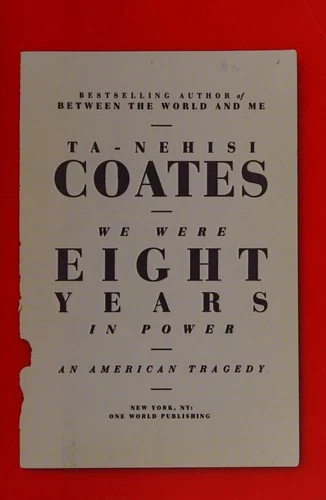
Read the decisions beneath the cover.
Make a collection into a record of development by placing specific later assessments beside the earlier work, and give broad social explanations concrete interactions to inspect.
Especially useful for: Essayists, reporters and documentary memoirists revisiting older work or connecting personal accounts with institutional history.
How the decisions work together
The book’s new material does more than introduce reprints: it exposes a developing writer and distinguishes later judgments from the essays that prompted them. Within the reported arguments, linked institutional conditions give the larger claims a more specific explanatory form.
- Declare the historical question
The introduction connects the title’s Reconstruction source to Coates’s reading of the Obama period.
- Pair work with retrospect
Eight Notes/essay pairs keep the published artifacts beside later accounts of their making and limits.
- Expand the reported argument
The reparations and incarceration essays connect lived accounts with policies and institutional interactions.
- Reassess the period’s aftermath
The final essay and epilogue consider the election’s consequences while rejecting inevitability.
2 decisions worth studying.
Start with the choice. Open its application and limits, or follow the source example.
Keep the earlier essay beside a specific later assessment
Identify a contemporaneous document, preserve enough of its actual claim or approach for inspection, and distinguish it from later commentary about its making, omissions or changed interpretation.
Explore the decision, application & limits
Why this choice matters
The Notes let readers encounter both the earlier published work and a later authorial assessment. Specific disclosures give the juxtaposition work to do: a reader can notice what an essay contains, what it leaves out and how the writer now judges the choice. Repetition across the collection makes intellectual and professional development part of its architecture.
Try the decision in your own work
- Keep the earlier artifact and the later commentary clearly distinguishable, with their temporal relationship stated.
- Name the earlier intention or claim and a specific present assessment, rather than attach a generic disclaimer.
- Point to what the reader can inspect in the retained piece, and distinguish acknowledging a defect from repairing it.
Show the institutions interacting around a family
Show why an individual or family-level explanation is incomplete, identify the surrounding institutions and interactions, and trace how they generate or sustain the observed outcome.
Explore the decision, application & limits
Why this choice matters
The Detroit discussion connects memories of community life to employment losses, constrained housing choices and the consequences of imprisonment. The sequence makes the family a participant in interacting conditions rather than a self-contained explanation. It gives the essay’s challenge to a family-centered diagnosis a concrete chain to examine.
Try the decision in your own work
- State the narrower explanation and identify the relevant conditions it leaves outside the frame.
- Trace how a change in one institution alters opportunities or constraints in another, using reported specifics.
- Return to the original explanation and show what it can no longer account for alone, while separating the proposed mechanism from proof of its causal strength.
Every chapter has a job.
Choose a section to see what it adds and which authoring decisions it makes visible.
American Girl
Michelle Obama’s upbringing and family history become the basis for a profile of belonging and aspiration. The essay considers what her biography adds to the public understanding of Barack Obama and of Black American life.
Its job in the book
Provide an earlier account of the promise surrounding the Obamas.
A decision to study
Choose a biographical emphasis that changes the familiar public story of the subject.
Supplied text · lines 347–436. Summary and role are our analysis.
Link to this chapterThe book’s subject and overall argument
Ta-Nehisi Coates places eight essays from The Atlantic beside new retrospective notes about his life, reading, reporting and developing arguments during the Obama years. The introduction draws the title from a Reconstruction-era speech and proposes a connection between successful Black government and the opposition it can provoke. The essays range from profiles of Bill Cosby and Michelle Obama to the Civil War, Malcolm X, presidential politics, reparations and mass incarceration.
The notes turn the collection into a second narrative about writing: Coates identifies ambitions, debts, omissions and interpretations he no longer finds adequate, while leaving the earlier work available for inspection. The later essays connect personal accounts with historical policies and institutional conditions. An epilogue interprets Donald Trump’s election through the collection’s racial and historical argument, then rejects inevitability while calling for several forms of resistance. These political and historical interpretations are presented as Coates’s arguments, not independent findings of this study.
Build a collection from two distinguishable time layers: eight retrospective notes followed by the essays they discuss. The introduction and epilogue supply an overarching historical argument, while the paired notes make the development and limits of the published work part of the book’s subject.
Sources & reading scope
Ta-Nehisi Coates, We Were Eight Years in Power; supplied Hamish Hamilton/Penguin text, first British publication 2017, copyright BCP Literary, Inc. 2017, ISBN 978-0-241-98250-1; credits the eight essays as Atlantic reprints.
The completed whole-source AI synthesis supplied candidate observations and the broad argument map. This Codex editorial pass checked original source headings, section boundaries, openings and selected argumentative contexts; inspected every retained example; checked the existing pattern dictionary and base examples; and rewrote or rejected nominations. It is a source-checked editorial pass, not a new independently adjudicated whole-book reading.
- No human or independent-model review has been completed.
- The local extraction has not been compared page by page with a publisher edition; graphical layout and completeness are not independently certified.
- The book’s empirical and historical claims are described as claims made by the author, not independently verified findings of this study.
- Proposed effects on readers are editorial interpretations, not measured comprehension, behavior or longevity effects.
- The source explicitly lists first United States publication by One World and first British publication by Hamish Hamilton in 2017. ISBN 978-0-241-98250-1 identifies the supplied text; no page-by-page comparison with a printed edition was performed.
- The map covers the Introduction, eight Notes/essay pairs and the Epilogue. The Notes and essays are separate entries within their numbered chapter grouping. Numbered subdivisions within the three long essays and the Epilogue are retained in the private section outline, not presented as additional main chapters.
- The introduction says all eight essays originally appeared in The Atlantic. The source’s reprint credits are preserved without treating their copyright years as independently verified dates of first magazine publication. Retention is visible in this edition, but verbatim identity with the original magazine versions has not been independently compared.
- The retrospective notes are not a uniform set of corrections: they include memoir, aesthetic reflection, changed judgments, acknowledged omissions and accounts of research. A later admission does not by itself repair the earlier reporting or establish the later judgment’s accuracy.
- The study keeps political arguments, historical explanations, remembered conversations, allegations and reported empirical findings attributed to the text and its named sources. It neither adjudicates those claims nor supplies current political, legal or policy advice.
- The source’s endnotes chiefly accompany the mass-incarceration essay and My President was Black; they should not be described as a comprehensive note system for all eight essays.
- Proposed reader effects describe the editorial function of the arrangement. They do not establish increased trust, agreement or comprehension.
Editorial source check by Codex. No human or independent-model review is claimed. Chapter locations refer to the supplied transcription, not printed page numbers.