Under the Sea-Wind
Follow individual lives through the changing conditions and encounters that connect the shore, open water and rivers.
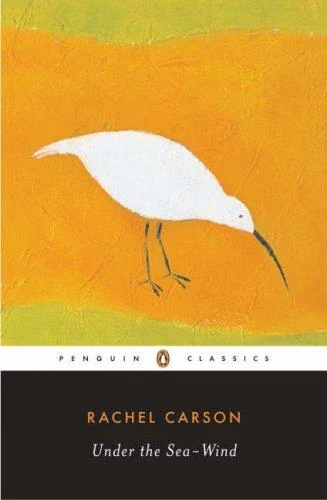
Read the decisions beneath the cover.
Let encounters connect the participants, then make the ending’s larger timescale change what the local cycle means.
Especially useful for: Writers explaining interacting lives and long processes through a narrative that needs more than one protagonist.
How the decisions work together
Fifteen chapters move through the shore, open sea and river-to-sea cycle. Direct encounters transfer attention among animals, while the returning eels supply the ending’s link to geological time. The study treats these as crafted representations and keeps historical science and the later publisher biography within their source limits.
- Connect through encounters
Let contact carry attention and consequence to the next participant.
- Keep cycles legible
Use recurring animals and changes of habitat to organize movement.
- Change the timescale
Carry a local return into the longer process that changes the surrounding landscape.
2 decisions worth studying.
Start with the choice. Open its application and limits, or follow the source example.
Let an encounter carry the story to its next participant
Move narrative attention from one participant to another through their direct encounter, then follow the new participant into a connected encounter so the relationships themselves organize the sequence.
Explore the decision, application & limits
Why this choice matters
The transition carries information about the system as well as moving the story. A creature may be a hunter in one moment and another creature’s prey in the next, making its place in the web visible through action.
Try the decision in your own work
- Establish one participant and the immediate action it is pursuing.
- Use an encounter to introduce or redirect attention to the next participant.
- Follow the consequence into another connected action while retaining the shared setting or process.
- Distinguish an illustrative constructed sequence from observations that establish the actual frequency or mechanism of the interactions.
Let the closing cycle change the scale of permanence
Carry the returning eels’ cycle into a larger temporal frame, then identify what that changed timescale makes temporary in the surrounding landscape.
Explore the decision, application & limits
Why this choice matters
The final comparison retains the local waiting scene while changing its reference scale. Coasts, mountains and human settlements acquire a different apparent permanence when the narrative moves from an animal’s life to geological time.
Try the decision in your own work
- Keep an identifiable local action or cycle in the final scene.
- Make the transition to the larger timescale explicit.
- Name what changes under that scale, rather than ending with size or duration alone.
- Preserve the distinction between a narrative projection and a tested prediction about a particular place or date.
Every chapter has a job.
Choose a section to see what it adds and which authoring decisions it makes visible.
A Biography of Rachel Carson and archival captions
The reissue adds a later account of Carson’s life and a captioned archival gallery. These materials frame the author from the publisher’s perspective and sit after the narrative and glossary.
Its job in the book
Provide later publisher context with a distinct authorship and evidence status.
A decision to study
Make the boundary between an author’s work and a later publisher’s framing easy to recognize.
Supplied text · lines 1585–1641. Summary and role are our analysis.
Link to this chapterThe book’s subject and overall argument
Three Books follow coastal, oceanic and river-to-sea life through fifteen chapters. Recurring animals give migration, feeding, reproduction and danger individual continuity, while tides, weather, currents and seasons repeatedly transfer attention to the lives around them.
The study focuses on encounters that carry the story between participants and a final enlargement from the returning eels to geological time. These choices make relationships and duration narratable. Their ecological and sensory claims remain those of the supplied natural-history text, with the later publisher biography treated separately.
The three Books change habitat and recurring animal while retaining cycles of movement, survival and return. Encounters connect the participants within scenes; the last chapter completes a generational movement before enlarging the temporal scale to the coast itself.
Sources & reading scope
Supplied 2011 Open Road reissue text: fifteen chapters, glossary and later publisher back matter; referenced images absent.
Confirmed the current development-family gate before source access. Read the complete whole-source AI synthesis and the summaries, section maps, qualifications and gaps of all four ordered segments. Checked every numbered chapter against the contents and body, inspected all chapter openings and endings, and read the retained encounters and complete closing sequence in their actual source context. Inspected the glossary, publisher biography, captions and imprint for role and edition boundaries. This is a source-checked editorial pass, not a second complete reading, independent-model review or ecological audit.
- The imprint identifies a 2011 Open Road Integrated Media edition, ISBN 978-1-4532-1473-2, preserving copyright 1941 by Rachel L. Carson. The filename’s 2010 date is not used as the edition date. No publisher-controlled copy was compared.
- All fifteen main chapters and the glossary are present. References to illustrated species and an archival image gallery survive as text, but the images are absent from the supplied source.
- The animal encounters, sensed worlds, motives and individual journeys are literary representations in this natural-history narrative, not independently verified observations of those particular animals. Ecological facts and the imagined chronology of eel migration have not been audited.
- The narrative sometimes marks uncertainty and sometimes attributes mental states directly. A local qualification does not make the entire portrayal a consistent record of measured animal cognition.
- The later biography and image captions are publisher back matter. They contain claims and an internal date inconsistency that are not used as Carson’s self-account or as independent biographical authority.
- Reader effects are editorial inferences. Neither ecological validity nor claims about sales, influence or independent author-family replication are established by these observations.
Editorial source check by Codex. No human or independent-model review is claimed. Chapter locations refer to the supplied transcription, not printed page numbers.