The waiting eels lead into the coast’s longer cycle
A book can grow by changing the scale of the question while keeping its central idea in view.
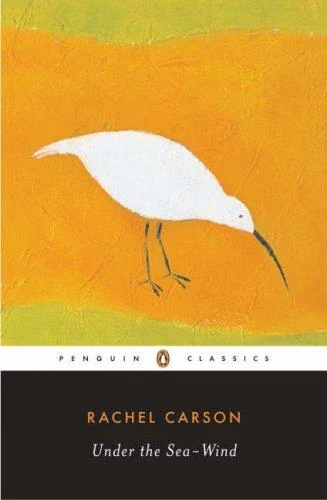
Under the Sea-Wind
Rachel Carson · 19 weeksThe waiting eels lead into the coast’s longer cycle
SHORT SOURCE EXCERPT“a moment in geologic time”
The closing passage follows elvers waiting offshore and projects their coming movement into rivers. It then makes the sea itself a waiting presence and treats the current relation of water, coastal plain and mountain ranges as temporary.
The comparison keeps waiting and return in view while changing the timescale. Its consequence is concrete: places that seem stable within an animal’s life, including settlements, enter the larger process of erosion and changing coastlines.
The source in context.
An explicitly uncertain account of the eels’ unseen migration leads to larvae, ocean layers and the new generation’s return toward coastal rivers. The final paragraph carries their waiting into geological time, making the coast itself temporary.
Open this chapterWhat this example supports
The comparison keeps waiting and return in view while changing the timescale. Its consequence is concrete: places that seem stable within an animal’s life, including settlements, enter the larger process of erosion and changing coastlines.
Its limit
This is a source-visible enlargement of temporal scale, not an independently verified prediction of when or how any particular coast or city will be submerged.
Source & edition
Supplied 2011 Open Road reissue text: fifteen chapters, glossary and later publisher back matter; referenced images absent.
Supplied text, lines 1274–1286. The short quotation is checked against the source.
Confirmed the current development-family gate before source access. Read the complete whole-source AI synthesis and the summaries, section maps, qualifications and gaps of all four ordered segments. Checked every numbered chapter against the contents and body, inspected all chapter openings and endings, and read the retained encounters and complete closing sequence in their actual source context. Inspected the glossary, publisher biography, captions and imprint for role and edition boundaries. This is a source-checked editorial pass, not a second complete reading, independent-model review or ecological audit.
Open Road Integrated Media reissue, 2011; ISBN 978-1-4532-1473-2. The imprint preserves copyright 1941 by Rachel L. Carson. Referenced illustrations and archival images are absent from the supplied text.