Freakonomics
Learn how the authors use unusual questions, incentives and data to investigate everyday behavior, then carry that skeptical questioning into other cases.
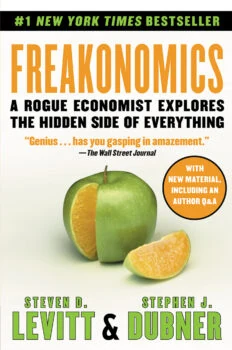
Read the decisions beneath the cover.
Make a recurring method visible in the reader’s experience: pose a mismatch, reveal the relevant incentives or evidence, and explain the comparison that earns the proposed answer.
Especially useful for: Writers combining varied investigations or making statistical and institutional explanations accessible to a general audience.
How the decisions work together
The subjects change, but the questions and inferential work recur. Its most useful craft decisions show why a distinction is needed, expose enough reasoning for readers to inspect it, and replace collective labels with different roles when their incentives conflict.
- Promise an investigative method
The introduction uses several cases before stating recurring ideas about incentives, information and measurement.
- Teach the method through cheating and information
The first two chapters make hidden behavior and informational advantage concrete.
- Extend the causal questions
Gang organization and the decline of crime demand more complex explanations and competing accounts.
- Bring the inquiry into family choices
Parenting and names place correlation, prediction and limits close to the reader before the epilogue returns to uncertainty.
3 decisions worth studying.
Start with the choice. Open its application and limits, or follow the source example.
Make the case concrete before explaining the framework
Give the reader a specific situation to interpret, then use the formal explanation to make sense of it; the label or a general overview may already be present.
Explore the decision, application & limits
Why this choice matters
The day-care fine provides a failure that the three-part incentive distinction can explain. Returning to the same fine after the taxonomy shows why the distinction matters, giving the book’s repeated incentive lens a concrete starting point.
Try the decision in your own work
- Choose a case whose unresolved behavior depends on the distinction you will teach.
- Give enough orientation for the reader to understand the stakes without presenting the entire explanation first.
- After defining the distinction, return to the case and specify what the new terms help explain.
Let the reader reconstruct the inference
Present concrete inputs and the intermediate reasoning that connects them to a conclusion, including an alternative explanation or test that could change the result.
Explore the decision, application & limits
Why this choice matters
The classroom demonstration moves from possible traces of answer changing to printed responses, reasons for suspicion and a follow-up comparison. It gives readers several places to examine the reasoning instead of asking them to accept only an impressive finding.
Try the decision in your own work
- Select inputs that let readers follow the actual inference, and state what each mark or number represents.
- Explain why the pattern favors the proposed account over a plausible alternative.
- Show what further comparison would challenge the inference, and distinguish an illustrative display from the full statistical procedure.
Find the system behind the behavior
Show why an individual-level explanation is incomplete, identify the surrounding incentives and interactions, and trace how they generate the observed outcome.
Explore the decision, application & limits
Why this choice matters
The chapter first undermines the assumption that a drug dealer necessarily earns well, then explains low-paid participation and violence through position, promotion and competing interests. Differentiating boss and subordinate gives the system more explanatory precision than treating the gang as one actor.
Try the decision in your own work
- Break a collective label into roles with different rewards, risks and available choices.
- Trace how those differences interact to produce the behavior that initially looked puzzling.
- Include evidence about constraints and keep a clear mechanism separate from a claim that it is the only cause.
Every chapter has a job.
Choose a section to see what it adds and which authoring decisions it makes visible.
Two Paths to Harvard
The epilogue restates the aim of encouraging questions and qualifies the likely practical benefits of reading the book. It returns to two boys described earlier and reveals their identities, making the limits of prediction the final narrative point.
Its job in the book
Close the method-oriented promise with a return to an unresolved human outcome.
A decision to study
Let the ending qualify the reach of the method, and distinguish a memorable contrast from a general statistical proof.
Supplied text · lines 3152–3180. Summary and role are our analysis.
Link to this chapterThe book’s subject and overall argument
Steven D. Levitt and Stephen J. Dubner connect apparently unrelated questions through a recurring way of looking: identify incentives, question familiar explanations and search for data that can distinguish alternatives. Schoolteachers, sumo wrestlers, real-estate agents and drug dealers become settings for examining why people’s actions may differ from the stories told about them. The authors present economics as a set of investigative tools rather than a restriction on subject matter.
The later chapters examine the authors’ explanations for falling crime and what evidence about parents and children does or does not show. Lists, small calculations, answer strings and invitations to guess repeatedly turn exposition into an encounter with evidence. The epilogue returns to the uncertainty of individual outcomes. This supplied revised and expanded edition also includes corrections, an account of the collaboration, columns and blog excerpts; its arguments are examined as the authors’ claims, not independently validated contemporary findings.
Unite a changing set of subjects through a recurring investigative method. Begin with an apparent mismatch, expose incentives or information that the ordinary account misses, and make the reader inspect enough of the reasoning to understand the proposed explanation.
Sources & reading scope
Steven D. Levitt & Stephen J. Dubner, Freakonomics; supplied revised and expanded edition, copyright 2005 and 2006; Adobe Digital Edition September 2009, ISBN 9780061792809.
The completed whole-source AI synthesis supplied candidate observations and the broad argument map. This Codex editorial pass checked original source headings, section boundaries, openings and selected argumentative contexts; inspected every retained example; checked the existing pattern dictionary and base examples; and rewrote or rejected nominations. It is a source-checked editorial pass, not a new independently adjudicated whole-book reading.
- No human or independent-model review has been completed.
- The local extraction has not been compared page by page with a publisher edition; graphical layout and completeness are not independently certified.
- The book’s empirical and historical claims are described as claims made by the author, not independently verified findings of this study.
- Proposed effects on readers are editorial interpretations, not measured comprehension, behavior or longevity effects.
- The title page identifies both Steven D. Levitt and Stephen J. Dubner. The CSV’s abbreviated single-author field must not displace the source-supported joint attribution.
- The supplied text is the revised and expanded edition, not the unchanged 2005 original. The preface describes removing former chapter-opening profile excerpts and correcting the Kennedy account; the article Hoodwinked? provides additional discussion at LF 3632–3678.
- The ten map entries cover the explanatory note, revised preface, introduction, six main chapters and epilogue. Bonus material begins at LF 3181, notes at 4322 and acknowledgments at 4573; supplementary columns, blog posts, lists and index entries are not additional main chapters.
- Some tables or typographic emphasis are not faithfully represented by the plain-text extraction. The answer strings and the explanatory prose are present, but the source’s referenced boldface and every graphical table have not been independently checked.
- The source includes contentious causal and social claims. This is analysis of the writing, not independent validation of the crime, parenting, discrimination or other empirical conclusions.
Editorial source check by Codex. No human or independent-model review is claimed. Chapter locations refer to the supplied transcription, not printed page numbers.