The Serviceberry
Reconsider familiar assumptions about value, scarcity and exchange through ecological relationships and concrete practices of giving, while considering where those analogies fit and where they become strained.
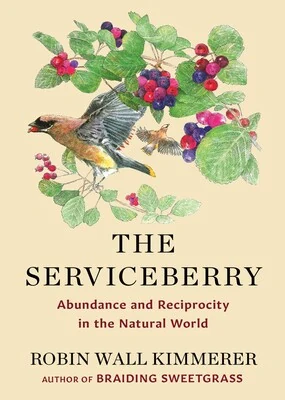
Read the decisions beneath the cover.
Give every return to the same concrete scene a new question, and make larger examples expose new conditions rather than repeat the initial intuition.
Especially useful for: Writers weaving personal observation, scientific explanation and an ethical argument into a continuous essay.
How the decisions work together
Berry picking supplies the essay’s concrete ground. Language and ecology establish reciprocity; historical and everyday examples expand its possible forms. Sharing a book becomes neighborhood and civic provision, bringing new questions about obligation and trust. Returns to the berry patch ask about material circulation, scarcity and the farmer’s mixed motives, keeping the setting active while the argument changes. The main essay closes with a reciprocal invitation; the separately titled An Offering is supplementary, not its ending.
- Start from a received gift
Use the berry-picking scene, language and ecological exchange to establish the relations the essay will examine.
- Extend the idea and test its limits
Move through personal, neighborhood and civic sharing while naming obligations, funding differences and breaches of trust.
- Return with changed questions
Revisit the berries and the working farm to examine scarcity, mixed gift/market motives and possible economic change.
- Keep the source regions distinct
Separate the main essay’s invitation from the following publication pledge, acknowledgments and An Offering.
2 decisions worth studying.
Start with the choice. Open its application and limits, or follow the source example.
Return to one concrete scene with a new explanatory job
Return to a recognizable physical setting or object at several points in an argument, making a newly developed question change what readers can notice there.
Explore the decision, application & limits
Why this choice matters
The repeated setting can orient readers across conceptual detours while showing that the argument has advanced. Its value comes from the new question on each return, not from repetition of an attractive image.
Try the decision in your own work
- Choose a setting or object whose observable features can answer more than one question.
- Give each return an explicit new explanatory job that depends on intervening material.
- Use a later return to qualify the account where the lived details complicate its initial contrast.
One idea, widening circles
Develop the same central idea at larger social or organizational scales, making each larger setting reveal a new constraint or question.
Explore the decision, application & limits
Why this choice matters
The sequence makes scale consequential: personal generosity, shared infrastructure and public funding no longer look interchangeable. Readers can follow one relation while noticing what its extension requires.
Try the decision in your own work
- Start with a small instance whose relationship readers can understand.
- Move to a larger unit that changes an obligation, resource or failure mode.
- State where the larger case is only an analogue and where the original definition stops fitting.
Every chapter has a job.
Choose a section to see what it adds and which authoring decisions it makes visible.
AN OFFERING
This separately titled piece follows a childhood coffee offering and the narrator’s changing understanding of it. A later conversation with her father complicates its assumed origin before she interprets the ceremony’s meaning again.
Its job in the book
Offer a distinct family narrative about reciprocity and belonging.
A decision to study
Keep a supplementary piece’s structure and ending distinct from the main essay.
Supplied text · lines 419–465. Summary and role are our analysis.
Link to this chapterThe book’s subject and overall argument
Robin Wall Kimmerer begins among berry bushes and birds, treating the fruit as a gift whose receipt carries a relationship. The continuous essay moves through plant ecology, Potawatomi language and teachings, conversations with an ecological economist, and examples of sharing in everyday life. Its central question is how provision might be organized around reciprocal relationships rather than accumulation alone.
The argument repeatedly returns to the berry patch as a place to examine the ideas it has introduced. Books passed to friends, neighborhood exchanges and civic institutions test different scales of sharing; the farmer’s own explanation complicates any simple division between gift and commerce. The main essay ends with an invitation to reciprocate. The supplied edition then includes a separate invitation, acknowledgments and the distinct piece An Offering; that later family narrative is not treated here as the ending of the main essay.
Keep one sensuous scene available as the essay moves through definitions, examples, objections and possible change. Revisit that scene with a new question, and enlarge the social scale without hiding the new obligations or limits the larger setting introduces.
Sources & reading scope
Robin Wall Kimmerer, The Serviceberry; supplied local ebook text, copyright 2024; colophon states First Scribner hardcover edition November 2024, ebook ISBN 9781668072257; exact display edition not independently established.
The completed whole-source AI synthesis supplied candidate observations and the broad argument map. This Codex editorial pass checked original source headings, section boundaries, openings and selected argumentative contexts; inspected every retained example; checked the existing pattern dictionary and base examples; and rewrote or rejected nominations. It is a source-checked editorial pass, not a new independently adjudicated whole-book reading. The source-region override for this exact SHA was preserved: main essay through line 389, invitation 395–400, acknowledgments 406–413, and separate An Offering at 419–465. The seven main-essay map entries are explicitly editorial divisions, not chapter titles in the book.
- No human or independent-model review has been completed.
- The local extraction has not been compared page by page with a publisher edition; graphical layout and completeness are not independently certified.
- The book’s empirical and historical claims are described as claims made by the author, not independently verified findings of this study.
- Proposed effects on readers are editorial interpretations, not measured comprehension, behavior or longevity effects.
- The main essay is continuous and unnumbered. Descriptive labels in its map are editorial aids; the supplied text does not establish original print page design or illustrations.
- The separate post-acknowledgments piece An Offering appears in the supplied file, but its original publication history was not checked. Its closing reversal must not be attributed to the main essay’s ending.
- The economic and ecological comparisons are the author’s arguments and analogies; this analysis neither makes natural systems identical to human institutions nor independently verifies the scientific claims.
Editorial source check by Codex. No human or independent-model review is claimed. Chapter locations refer to the supplied transcription, not printed page numbers.