The Last Battle
Follow the capture of Berlin through the ordinary people caught in it, while explaining the command decisions that shaped their narrowing options.
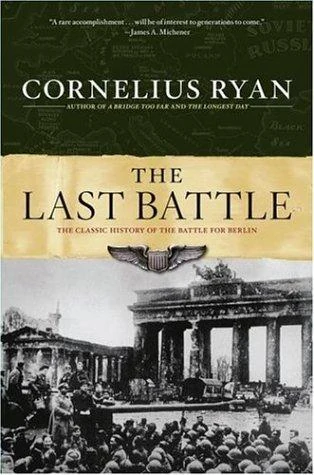
Read the decisions beneath the cover.
Choose a recurring place whose practical problem can change as the larger story advances, then make the final return answer what the outcome means there.
Especially useful for: Writers building histories or ensemble narratives across many participants and scales, who need a concrete way to connect changing conditions to lived consequences.
How the decisions work together
The promise to follow ordinary people determines the architecture: the city establishes what is at stake, command and policy explain the pressures, and the battle returns those pressures to recurring lives. The zoo’s changing problems connect food, failed infrastructure and post-battle recovery. Its final return completes that thread without settling the larger event’s moral or historical questions.
- Establish the people at stake
The foreword and city mosaic define survival as the question the larger history must answer.
- Build the pressures around them
Command, objectives and decisions explain why the city’s options narrow.
- Return for changed consequences
The battle revisits familiar lives and places, then ends at the human scale promised at the start.
1 decision worth studying.
Start with the choice. Open its application and limits, or follow the source example.
Return to one concrete scene with a new explanatory job
Return to a recognizable setting, object or shared occasion at several points in a book, making a question developed by intervening events or ideas change what readers can notice there.
Explore the decision, application & limits
Why this choice matters
A familiar anchor gives readers a concrete way to notice how the book has advanced. Each return reveals a changed question or relationship instead of repeating an attractive image.
Try the decision in your own work
- Establish a setting, object or occasion whose observable features can answer more than one question.
- Give each return a distinct question that depends on the events or ideas introduced since its last appearance.
- Let the later details develop or qualify the earlier reading, while keeping inference and fact distinct.
Every chapter has a job.
Choose a section to see what it adds and which authoring decisions it makes visible.
Part One: The City
A mosaic of Berliners establishes the damaged city, its fears and the routines still continuing in March 1945. The part ends by making the need for a commander a question that the next part can answer.
Its job in the book
Make the stakes concrete before introducing the command solution.
A decision to study
Let the next major section answer a question produced by the current one.
Supplied text · lines 107–731. Summary and role are our analysis.
Link to this chapterThe book’s subject and overall argument
Ryan organizes the fall of Berlin around a question larger than the assault itself: what the last battle meant to soldiers and civilians whose options were closing. Five parts move from the threatened city to command, Allied objectives and competing decisions before the fighting gathers those strands together.
The book makes that breadth manageable through recurring people and settings, while selected notes reveal disagreements beneath some of its most vivid scenes. Its final civilian moments complete the stated survival-centered promise; the casualty note and participant register then expose different limits and dimensions of the record.
City, commander, objective and decision build the conditions for the battle. Recurring civilian threads make changes in those large conditions visible at a smaller scale. Selected notes disclose source disputes, sometimes beneath scenes narrated more precisely than those notes establish.
Sources & reading scope
Cornelius Ryan, The Last Battle, supplied Simon and Schuster text identifying the 1966 copyright and 1994 renewal.
Read the existing whole-source synthesis and all ten ordered segment summaries, section maps, qualifications and gap reports. Checked the five part headings against the contents, the opening and closing passages of each part, the main ending, and the casualty note, contributor register and acknowledgment boundaries. Read all retained example contexts, including the complete stork thread and both source-disagreement notes. Verified all ten consecutive source-input hashes and successful machine receipts. This is source-checked editorial review using the prior machine reading, not a new second full-book reading, independent review or historical fact audit.
- The supplied text identifies the 1966 copyright and 1994 renewal; its exact digital edition is not established by the filename. The catalog's date is not used as a publication fact.
- The five main parts and substantive narrative ending are present. The index reaches Zossen but its last populated line ends with a comma; the text also has OCR and line-break defects. This supports the supplied prose map, not certification of every page, map or complete index in a publisher edition.
- Ryan reconstructs scenes and speech from participants and documents. Exact source checking verifies what this book says, not that its historical claims or remembered dialogue are correct.
- Some source conflicts are explicit, but vivid scenes still exceed the precision the notes can independently establish. Notes about the quarrel and concert are selected disclosures, not proof of consistent treatment throughout the book.
- The acknowledgments describe uneven access and a collaborative research operation. The study makes no representativeness claim for the witnesses, no current-historiography claim, and does not treat graphic atrocity descriptions as self-authenticating evidence.
- The book's assessments of commanders and its attribution of motives remain authorial judgments. The causal and legal merits of wartime decisions have not been independently evaluated.
- The zoo thread contains an internal room-label inconsistency: bathroom in its initial and later appearances, bedroom in the water-shortage passage. Its narrative role does not resolve that discrepancy.
- Reader benefits are editorial interpretations, not measured effects. No longevity, market-outcome or independent author-family replication is claimed.
- The source-disagreement scenes are not retained as examples of that writing practice: acknowledging conflicting recollections does not by itself make the main narrative’s precision agree with the uncertainty.
Editorial source check by Codex. No human or independent-model review is claimed. Chapter locations refer to the supplied transcription, not printed page numbers.