The Dragons of Eden
Follow an accessible, explicitly speculative synthesis about the origins and possibilities of intelligence, using familiar scales, worked explanations and comparisons to approach difficult material.
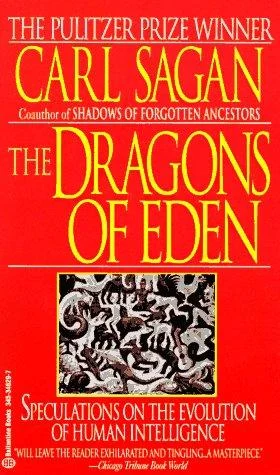
Read the decisions beneath the cover.
Give difficult magnitudes a consistent scale, then make the assumptions and intermediate steps behind memorable comparisons available to inspect.
Especially useful for: Explanatory writers working with extreme timespans, unfamiliar quantities and provisional scientific accounts.
How the decisions work together
The early chapters supply reusable ways to think about scale and information before the book’s historical brain models and speculations develop. The retained lessons concern those explanatory choices; they preserve the difference between a clear representation and a scientifically established account.
- State the inquiry and its limits
The Introduction connects learning, adaptation and extraterrestrial intelligence while qualifying the author’s synthesis.
- Install scale and information
The calendar and worked information examples provide reference tools for later chapters.
- Explore models and capacities
Brain models, human evolution, animal behavior and dreams develop the historical argument.
- Return through possible futures
Computers and extraterrestrial communication bring the inquiry back to learning and survival.
2 decisions worth studying.
Start with the choice. Open its application and limits, or follow the source example.
Reuse one familiar scale for unfamiliar quantities
Define an explicit quantitative mapping from an unfamiliar magnitude to a familiar scale, place several examples on it, and reuse the same mapping later so comparisons remain connected.
Explore the decision, application & limits
Why this choice matters
The calendar gives readers one set of familiar coordinates for cosmic, biological and historical intervals. Later references to days or late December can build on that mapping instead of introducing a new scale each time. The common frame makes the book’s emphasis on the recency of human capacities easier to compare across chapters.
Try the decision in your own work
- Choose a familiar scale with enough room to preserve the comparisons that matter, and state the conversion explicitly.
- Place several meaningful examples on it, distinguishing precise conversion from uncertain or selective input data.
- Reuse the same mapping when a later argument needs comparison; retain the scale’s assumptions and avoid treating a memorable position as causal evidence.
Show the assumptions between a quantity and its familiar equivalent
Present the inputs and intermediate reasoning that lead to a conclusion, keeping the assumptions and possible errors available for inspection.
Explore the decision, application & limits
Why this choice matters
The letter demonstration makes a bit count concrete before the text works through letters, words, pages and volumes. Showing the intervening assumptions explains how the library image was obtained and gives a reader specific steps to question. The source’s earlier coding inconsistency also shows why visible reasoning is useful without making transparency a guarantee of correctness.
Try the decision in your own work
- Start with an explicitly stated input and distinguish a measured value from an assumption.
- Work through each change of unit with its conversion and rounding visible.
- Check the input model as well as the arithmetic, and say which parts the demonstration does not establish.
Every chapter has a job.
Choose a section to see what it adds and which authoring decisions it makes visible.
Knowledge is Our Destiny: Terrestrial and Extraterrestrial Intelligence
The final chapter returns explicitly to the search for extraterrestrial intelligence and the machines it requires. Arguments about shared physical conditions, survival and disciplined inquiry close with another Cosmic Calendar reference and a return to Bronowski.
Its job in the book
Bring the explanatory tour back to its motivating question.
A decision to study
Reuse the opening frame to show the scope of the conclusion while preserving the uncertainty of its premises.
Supplied text · lines 1940–2014. Summary and role are our analysis.
Link to this chapterThe book’s subject and overall argument
Carl Sagan investigates the evolution of human intelligence by connecting evolutionary history, genetic and neural information, brain models, animal behavior, dreams and tools for learning. An introductory account of slow genetic change and faster learned adaptation gives the inquiry its purpose. The Cosmic Calendar places that history on a familiar scale before more technical discussions compare information storage and introduce Paul MacLean’s triune-brain model.
The later chapters explore human and animal capacities, speculative accounts of sleep and dreams, and hemispheric specialization before turning to computers and the possibility of communication with extraterrestrial intelligence. Myths and literary passages supply comparisons throughout, while Sagan repeatedly identifies hypotheses and approximations. This study describes the presentation in the supplied historical text. Its neuroscience, evolutionary reconstructions and technological forecasts are not presented as current scientific conclusions.
Install scale and information concepts before presenting the brain models that organize later speculation. Reuse the early scale to connect distant stages of the inquiry, then return from earthly intelligence and learning tools to the opening question about intelligence elsewhere.
Sources & reading scope
Carl Sagan, The Dragons of Eden; supplied Ballantine/Random House ebook text, copyright 1977 by Carl Sagan, eISBN 978-0-307-80100-5, version v3.1_r2; the filename’s 2011 date is not confirmed by an internal publication-date statement.
The completed whole-source AI synthesis supplied candidate observations and the broad argument map. This Codex editorial pass checked original source headings, section boundaries, openings and selected argumentative contexts; inspected every retained example; checked the existing pattern dictionary and base examples; and rewrote or rejected nominations. It is a source-checked editorial pass, not a new independently adjudicated whole-book reading.
- No human or independent-model review has been completed.
- The local extraction has not been compared page by page with a publisher edition; graphical layout and completeness are not independently certified.
- The book’s empirical and historical claims are described as claims made by the author, not independently verified findings of this study.
- Proposed effects on readers are editorial interpretations, not measured comprehension, behavior or longevity effects.
- Internal metadata gives copyright 1977, Ballantine/Random House, eISBN 978-0-307-80100-5 and version v3.1_r2. It does not independently confirm the filename’s 2011 publication label. The backmatter promotes other Sagan books, including works coauthored with Ann Druyan; that promotion is not a coauthor credit for this book.
- All nine main chapters and the Introduction are mapped. Acknowledgments, Bibliography, Glossary and publisher promotions are covered separately. Titles use the contents wording and are checked against the line-broken body headings.
- The extraction contains captions and image references whose full visual information is not available here. Chapter 1 describes a December calendar graphic that is not represented as readable date rows in the supplied text. The retained scale examples rely on the explicit conversion, readable lists and later prose references.
- Sagan’s fifteen-billion-year calendar is this text’s chosen scale, not a current estimate of cosmic age. Specific event dates are approximate and selective, as Sagan states at LF322.
- MacLean’s triune-brain model, hemispheric generalizations, animal-language accounts, dream hypotheses and proposed consequences for medicine or public policy remain historical claims presented by Sagan. Their current validity has not been evaluated, and this study supplies no medical or policy advice.
- The Introduction distinguishes the author’s expertise from the subjects he is learning and describes many proposals as speculative. The source calls the triune account an approximation and cautions against clean functional separation; those qualifications do not independently validate the account.
- The nucleotide-to-bit step at LF453 is inconsistent with binary encoding of four alternatives: two bits can distinguish four alternatives. The admitted worked-conversion example starts with the text’s assumed bit total and does not treat the preceding genetic calculation or biological quantities as validated.
- The brain models and the book’s own method are not evidence that its rhetoric reproduces the brain’s actual operation. Proposed effects on readers remain editorial interpretations.
Editorial source check by Codex. No human or independent-model review is claimed. Chapter locations refer to the supplied transcription, not printed page numbers.