In Cold Blood
Follow a particular crime beyond its discovery into the people, explanations and judgments through which the account gives it meaning.
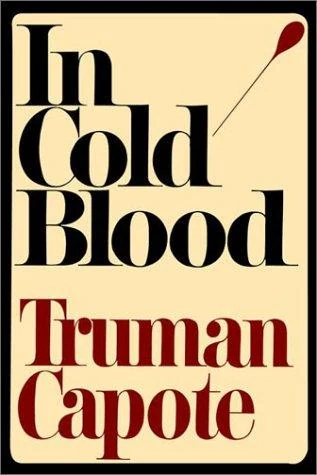
Read the decisions beneath the cover.
Make changes in the reader’s knowledge visible, and distinguish an event’s spoken words from explanations supplied outside it.
Especially useful for: Writers of reported or historical narrative who need to handle unequal knowledge, reconstructed perspectives and the limits of an institutional record.
How the decisions work together
The four sections move from parallel last-day scenes through investigation, answer and judgment. A repeated conversation changes meaning when a concealed premise is supplied; two trial passages distinguish the depicted answers from explanations labeled as unheard. Those devices can be analyzed without certifying the narrative’s reconstructed thoughts, testimony or psychiatric interpretations.
- Distribute knowledge unevenly
Show how the situation means different things to participants and readers.
- Return to identifiable words
Make new knowledge change the reading of a concrete earlier exchange.
- Preserve the status boundary
Label material supplied outside the event instead of making it seem spoken there.
2 decisions worth studying.
Start with the choice. Open its application and limits, or follow the source example.
Replay the same words after changing what the reader knows
Present an identifiable exchange from one participant’s understanding, disclose a relevant difference in another participant’s knowledge, and return to the same words so their changed meaning is visible.
Explore the decision, application & limits
Why this choice matters
The repetition makes the interpretive change inspectable. In the picnic scene, what initially functions as a remembered act underpinning Dick’s judgment is later presented as a boast Perry invented to shape that judgment.
Try the decision in your own work
- Establish the exchange and what one participant believes it means.
- Supply the specific new knowledge that changes the interpretation.
- Repeat or revisit identifiable words and details instead of merely announcing a different viewpoint.
- Make the basis for represented interior knowledge clear; do not treat an effective reconstruction as self-verifying.
Distinguish the spoken answer from the explanation the hearing excludes
Show the exchange and the constraint on what could be said, then explicitly label a supplementary explanation as material not spoken in that event, preserving the difference between the depicted hearing and what the writer adds for the reader.
Explore the decision, application & limits
Why this choice matters
The contrast makes the limits of the institutional exchange part of the explanation. The reader can see the short answer presented in court and a different layer of material that the book supplies outside that hearing, without being told that both were heard there.
Try the decision in your own work
- Establish what the source shows being asked and answered in the event.
- Identify the constraint and attribute the account of its effect.
- Mark the transition to material not spoken there, including whether it is prepared, subsequently supplied or reconstructed.
- Disclose the basis and uncertainty of the supplement; labeling its status is necessary but does not establish its provenance.
Every chapter has a job.
Choose a section to see what it adds and which authoring decisions it makes visible.
III. Answer
Floyd Wells’s account creates an investigative route through interviews, the pair’s movements, arrest and questioning. Confessions supply the fuller account of the crime that the opening withheld, while the text also notes differences in how responsibility is assigned. The section closes with the prisoners’ public arrival and the crowd dispersing from the courthouse square.
Its job in the book
Bring previously separate investigative and fugitive strands together, while locating the account of the crime within testimony.
A decision to study
An answer delivered through a participant’s account retains that account’s source and limits; narrative closure does not independently establish every detail.
Supplied text · lines 1131–2070. Summary and role are our analysis.
Link to this chapterThe book’s subject and overall argument
Four main sections move from the Clutter family’s last day and its aftermath through investigation, arrest, trial and the later consequences for the condemned and surviving community. Parallel scenes, reproduced documents and represented private thoughts distribute knowledge unevenly; the fuller crime account arrives through later testimony.
This study retains two precise decisions: returning to the same conversation after changing the reader’s knowledge, and separating the courtroom’s depicted answers from explanations labeled as not heard there. Their force depends on differences in perspective and source status. The study does not certify reconstructed dialogue, interiority, documents or the book’s clinical and legal interpretations.
The four main sections shift the dominant question from approaching catastrophe to investigation, answer and judgment. Knowledge arrives in different forms—scene, testimony, document and interpretation—and the final section makes the boundaries among those forms especially consequential.
Sources & reading scope
Supplied undated attributed text, four main sections through The End; edition and reporting apparatus unverified.
Read the complete whole-source AI synthesis and the summaries, section maps, qualifications and gaps of all seven ordered source segments. Checked all four main section headings, openings and endings against the supplied text, including its title/author block and final end marker. Directly inspected the complete repeated picnic conversation and both courtroom-answer/supplement sequences, including surrounding qualifications. This is a source-checked editorial pass, not a second complete reading, independent-model review or historical audit.
- The supplied text names In Cold Blood and Truman Capote and contains all four main sections through an end marker. It supplies no usable publisher, copyright, edition or reporting-method preface. The filename’s 2012 label is not treated as an established publication date, and no publisher-controlled edition was compared.
- The text contains broken words, spacing and paragraph splits consistent with imperfect extraction. Exact quotations are anchored to the supplied text without silently repairing its typography.
- Narrated events, dialogue, private thoughts, confessions and reproduced documents are the book’s representations. Their historical accuracy, authenticity and editorial reconstruction were not independently checked.
- The courtroom restrictions and psychiatric accounts are attributed to the book. No transcript, clinical record or independent legal history was consulted; the study does not validate a diagnosis, motive, legal conclusion or current clinical guidance.
- The narrative explicitly labels some material as what a witness would have said, but that label does not establish the provenance or exact wording of the proposed testimony.
- Reader effects are editorial inferences, not measured responses or demonstrated explanations of sales, influence or longevity.
Editorial source check by Codex. No human or independent-model review is claimed. Chapter locations refer to the supplied transcription, not printed page numbers.