The loop has three inspectable roles
Cue, routine and reward become repeated questions readers can ask of a case. The model earns its name by helping them locate something, compare something and eventually change something.
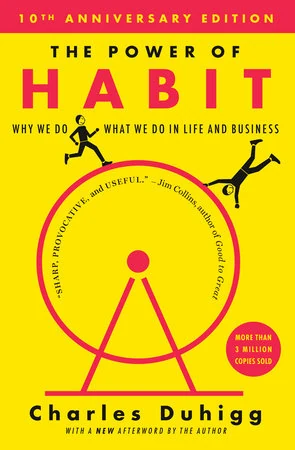
The Power of Habit
Charles Duhigg · 34 weeksThe loop has three inspectable roles
A repeated behavior is separated into its cue, routine and reward. The roles become questions readers can carry into another case.
Cue, routine and reward become repeated questions readers can ask of a case. The model earns its name by helping them locate something, compare something and eventually change something.
The source in context.
Eugene Pauly’s severe memory loss creates the chapter’s central contradiction. He repeats questions and cannot explain parts of his surroundings, yet he can find the kitchen and complete a familiar walk. Duhigg pauses that human story to examine laboratory work and introduce cue, routine and reward. He then returns to Eugene with the model in hand. Learning a correct choice between paired objects suggests one capability; presenting the objects differently reveals its limits. Everyday driving and repeated commercial cues extend the idea beyond the unusual patient. The closing family scenes preserve Eugene as a person whose experience matters beyond the explanatory use the chapter makes of it.
Open this chapterWhat this example supports
Cue, routine and reward become repeated questions readers can ask of a case. The model earns its name by helping them locate something, compare something and eventually change something.
Its limit
These are the book’s explanatory mappings. Identical labels do not establish identical mechanisms across animal learning, consumer behavior and clinical cases. The book itself warns that drawing a loop is not sufficient treatment.
Source & edition
Charles Duhigg, The Power of Habit (Random House, 2012), supplied ebook transcription.
Supplied text, lines 674–690. The description is an original editorial paraphrase, not a quotation.
Existing consecutive whole-source reading and chapter synthesis reused; three publication anchors reinspected in source. Chapter interpretation is editorial analysis.
2012 Random House supplied text, ebook ISBN 978-0-679-60385-6, version v3.1