Blink
Understand both the usefulness and the vulnerability of fast judgments, and see how experience and decision conditions might change them.
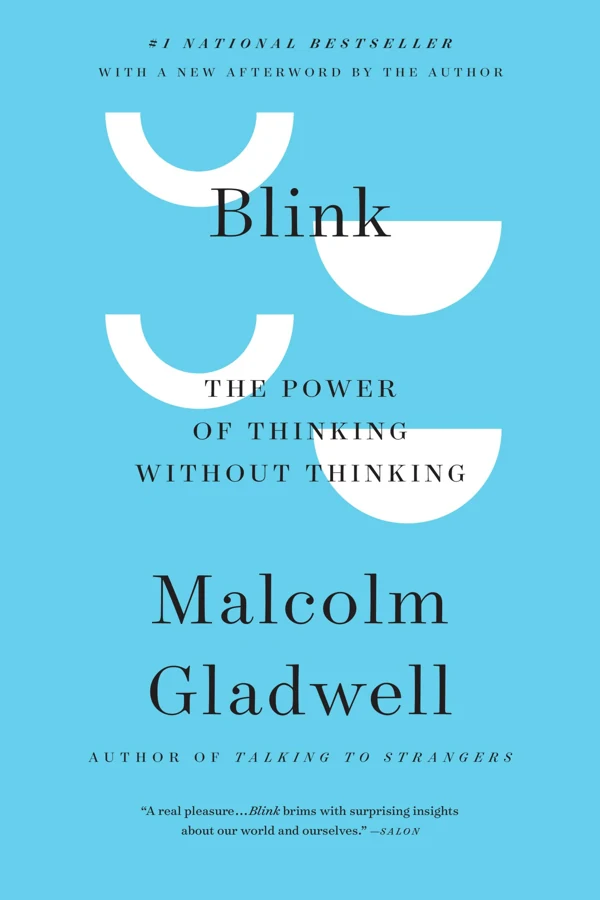
Read the decisions beneath the cover.
Build the promise around both the power and failure of your central idea, then make the ending show a concrete way to change its conditions.
Especially useful for: Writers explaining a counterintuitive idea that works in some situations, fails in others, and has practical implications.
How the decisions work together
The opening promises to explain rapid judgment's successes, its failures, and the possibility of shaping it. Those tasks give the movement among art, relationships, military exercises, consumer research, policing, and music a common purpose. Contrasting cases complicate the initial attraction of speed, while a staged analogy makes one proposed mechanism visible before returning to the harder case. The screened audition supplies the closing payoff: a concrete change in what a decision maker can see, rather than a general instruction to trust intuition.
- Promise both sides
Use a puzzling success to introduce rapid judgment, then commit to examining its failures as well as its possibilities.
- Complicate the explanation
Move through contrasting settings and make selected mechanisms inspectable through cases and analogy.
- Make intervention visible
Close with the audition screen as a concrete example of changing the conditions of judgment.
3 decisions worth studying.
Start with the choice. Open its application and limits, or follow the source example.
Make the obvious objection part of the promise
After a case supporting the central idea, name the contrary outcome and commit the book to explaining both.
Explore the decision, application & limits
Why this choice matters
The reader has a reason to continue through chapters that complicate the opening claim. Those chapters answer an announced question rather than seeming to abandon the book’s premise.
Try the decision in your own work
- State the positive claim at an appropriate level of certainty.
- Turn the most serious countercase into an explicit question the book will answer.
- Assign later material to each promised task and check whether the ending fulfills the practical one.
Demonstrate the analogy before transferring it
Pause the main case to show a second domain in action, expose a mechanism there, and then explicitly map it back.
Explore the decision, application & limits
Why this choice matters
The intervening scene gives the reader an observable model for an abstract proposition. The return to the first case makes the comparison’s intended job clear.
Try the decision in your own work
- Choose a second domain where the relevant relation can be observed.
- Show the operation, including a failure or changed version when available.
- Name both the shared relation and the limits of the transfer when returning to the original case.
End with a procedure that makes the principle visible
Close an abstract argument with a concrete change to the conditions under which its central action occurs.
Explore the decision, application & limits
Why this choice matters
A physical procedure gives the reader a compact way to remember a broad idea. The ending also answers the opening promise of possible intervention with something more specific than renewed encouragement.
Try the decision in your own work
- Choose a final case whose intervention can be described plainly.
- Show what information the intervention removes or changes and why that matters to the task.
- Keep the supported outcome distinct from wider applications suggested by the analogy.
Every chapter has a job.
Choose a section to see what it adds and which authoring decisions it makes visible.
The Locked Door: The Secret Life of Snap Decisions
A tennis coach can anticipate certain errors but struggles to explain how he knows. Other cases separate a person’s performance or reaction from the explanation that person can offer afterward.
Its job in the book
Complicate the assumption that people have direct access to the reasons for their judgments.
A decision to study
Make an inability to explain part of the puzzle rather than treating testimony about reasons as transparent evidence.
Supplied text · lines 237–360. Summary and role are our analysis.
Link to this chapterThe book’s subject and overall argument
Blink asks how a very brief encounter can produce an apparently informed judgment, and why the same speed can also mislead. Gladwell moves between art appraisal, relationships, tennis, politics, military exercises, consumer research, policing, and music. The recurring problem is not simply how quickly people decide, but what their experience, attention, and surroundings allow them to notice.
The book’s introduction makes three commitments: show the power of rapid judgment, examine its failures, and argue that it can be shaped. The later chapters make the second commitment complicate the first, while the conclusion turns a screened audition into a concrete image of changing the conditions of a decision. This study examines how that argument is staged; it does not independently validate the scientific and historical claims used to support it.
Begin with a puzzling success of rapid judgment, make its failure modes part of the promised investigation, and repeatedly compare cases until the ending offers a tangible change in procedure.
Sources & reading scope
Gladwell, Blink: The Power of Thinking Without Thinking; local text file labeled 2010, edition unconfirmed; LF line anchors.
Used the completed whole-source AI synthesis to identify candidate craft operations. Directly inspected introduction commitments, chapter headings and representative openings and endings, all published example spans, the chapter-four analogy and its explicit transfer, and the conclusion. Rewrote the study from those passages. This is a targeted editorial source check, not an independent scientific review or a new full rereading.
- The local extraction repeats portions of many paragraphs, contains merged headings, and omits an unambiguous edition notice. Line anchors refer to this extraction rather than printed pages.
- The examples establish what the book says and how it arranges material. They do not establish that the underlying studies replicate or that its interpretations are scientifically current.
- War-game, policing, and audition cases are presented through the book’s account; they have not been independently reconstructed here.
- A cross-domain analogy can clarify a proposed mechanism without proving that the mechanism explains every case.
- This study does not establish a causal connection between the identified craft choices and bestseller performance.
Editorial source check by Codex. No human or independent-model review is claimed. Chapter locations refer to the supplied transcription, not printed page numbers.